From Excavator Hitch to Tiltrotator: CATSU Supports Smarter Australian Fleets
Across Australia, excavators operate in conditions that place very different demands on machines and attachments. Civil contractors may move from utility trenches and road shoulders to drainage channels, subdivisions, landscaping, and remote infrastructure projects within the same operating season.
Machines must remain productive during long working shifts, while many jobs also require controlled grading and careful excavation around existing services. CATSU tiltrotator technology is designed to help contractors obtain more functional value from the excavator’s working end.
The attachment interface is central to that objective. An excavator hitch determines how the carrier connects to a bucket or hydraulic tool, while the tiltrotator determines how that tool can be positioned.
When these components are correctly specified as a complete system, the operator can change compatible attachments efficiently and use rotation and tilt to approach the work from a more effective angle.
Why the Hitch Is More Than a Connection Point
In Australian equipment terminology, excavator hitch is commonly used for the quick-coupling device installed at the end of the excavator arm.
Although the component may appear simple, its geometry, locking arrangement, pin compatibility, hydraulic configuration, and maintenance condition directly affect the attachment interface. It should therefore be considered alongside the excavator, tiltrotator, and work tools rather than selected independently.
Different fleets may use pin-grabber arrangements, dedicated coupler standards, or application-specific interfaces. Before installation, owners should confirm pin centres, pin diameters, working width, hydraulic pressure and flow, carrier capacity, and the dimensions of buckets already in service.
Accurate interface information reduces adaptation work and helps avoid a situation in which a new attachment system cannot use the fleet’s preferred tools.
An excavator hitch also operates through a much wider movement envelope when it is installed with a tiltrotator. Hose routing, attachment clearance, and locking visibility must be assessed in tilted and rotated positions, not only with the tool hanging vertically beneath the arm.
Daily inspection remains essential, including checks for secure engagement, contamination, damage, abnormal wear, and hydraulic leakage.
Tilt Buckets and Tiltrotators Serve Different Purposes
Many Australian contractors already use excavator tilt buckets for trimming batters, shaping drains, cleaning channels, and finishing road edges.
These buckets are practical because the tilting function is incorporated into a familiar work tool. For an excavator dedicated mainly to grading, a tilt bucket may provide the lateral movement required for a significant part of the machine’s workload.
A tiltrotator changes the equipment arrangement by placing tilt and continuous rotation above the attachment. This allows compatible digging buckets, grading buckets, grabs, and other tools to benefit from the same positioning system.
The distinction is important for mixed-work fleets. Instead of purchasing separate tilting capability with several tools, the contractor can place the additional movement at the machine-to-tool interface.
That does not make excavator tilt buckets obsolete. They remain useful attachments and may be the correct solution for a clearly defined application.
The important step is to match the equipment architecture to the machine’s operating pattern. An excavator that spends most of its working hours cutting long batters may have different requirements from a compact machine alternating between trenching, pipe exposure, backfilling, lifting, and landscaping.
Productivity Through Controlled Movement
On a busy subdivision or urban civil project, repositioning takes time and space. Tracking the excavator can disturb prepared ground, require additional traffic control, or place the machine closer to an excavation edge.
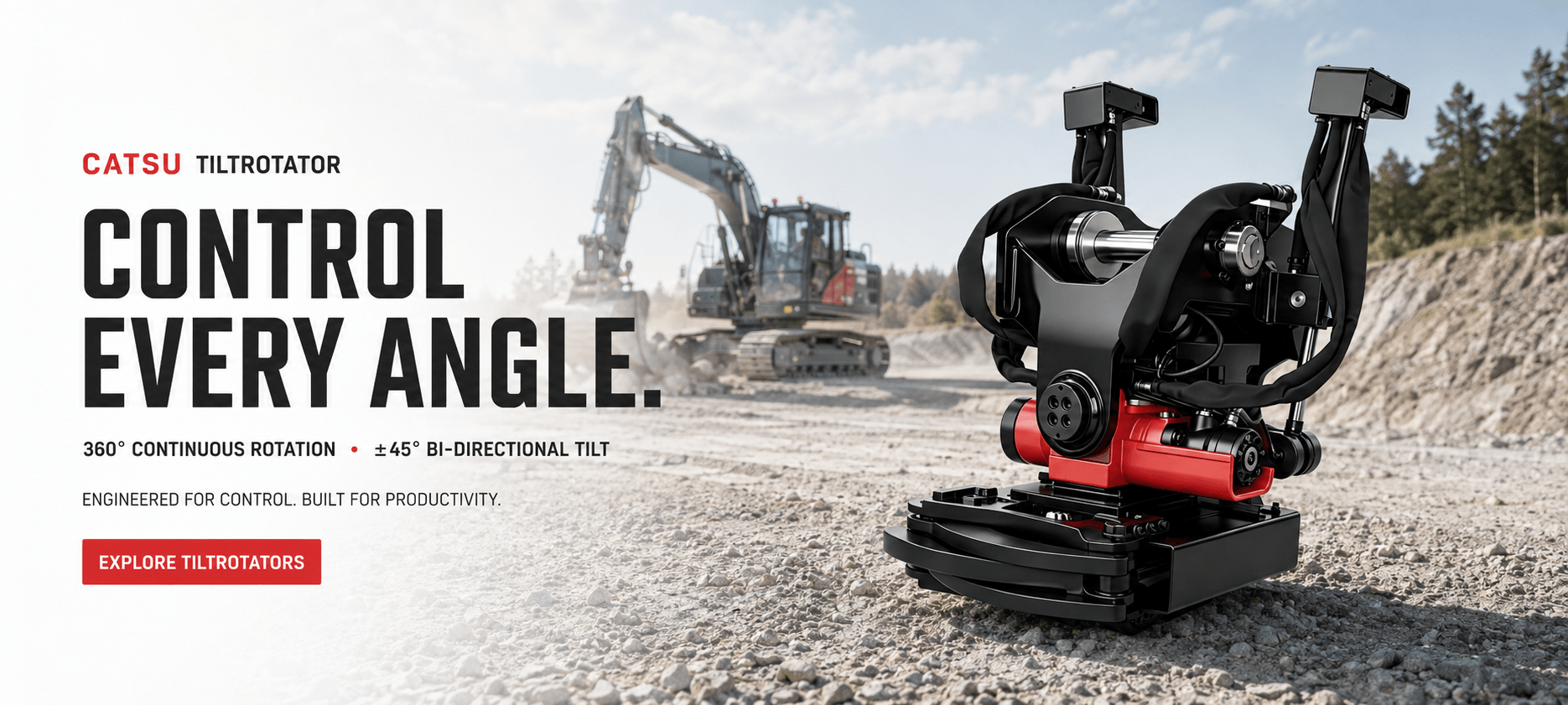
With continuous 360-degree rotation and bidirectional tilt, a CATSU tiltrotator allows the operator to adjust the tool orientation while keeping the carrier in a stable working position where site conditions permit.
The benefit is especially noticeable when finishing around pits, kerbs, pipes, retaining structures, and sloping surfaces. Excavator tilt buckets provide an effective way to change the cutting angle, while a tiltrotator adds rotational alignment.
The operator can manage material from different directions and form complex profiles with fewer interruptions to the digging cycle.
Proportional control is an important part of this process. Fine grading and work around underground services require predictable response instead of sudden attachment movement.
The CATSU control concept allows tilt and rotation to be metered through the operator controls. Correct setup should account for the excavator’s auxiliary hydraulic circuit and the response required for the selected attachment and application.
Evaluating New Equipment Against the Used Market
Cost-conscious buyers may search for a used tiltrotator for sale, particularly when equipping an older excavator or introducing tiltrotator technology to one machine within a fleet.
A used unit may appear financially attractive, but the purchase price alone does not reveal the cost or complexity of returning it to reliable service. The buyer must establish whether the equipment matches the excavator, coupler standard, hydraulic supply, electrical controls, and existing buckets.
When inspecting a used tiltrotator for sale, contractors should check the product identification, service history, structural condition, coupler locking components, tilt mechanism, rotation function, shafts, bushings, hoses, fittings, valves, wiring, connectors, sensors, and control components supplied with the unit.
Hydraulic leakage, impact damage, excessive play, corrosion, or missing harnesses can turn a low initial price into a difficult and expensive installation.
Compatibility with the existing excavator hitch must also be verified. A tiltrotator offered without the correct top interface, machine-specific mounting information, or compatible lower coupler may require engineering changes and additional components.
Buyers should not assume that two excavators in a similar tonnage class have the same attachment geometry or hydraulic arrangement.
A new and correctly specified CATSU system offers a different procurement route. The carrier model, installation interface, hydraulic requirements, control package, and intended attachments can be reviewed before supply.
For many fleet operators, integration support and component completeness are as relevant as the mechanical hardware itself.
Whole-of-Life Value on Australian Jobsites
Whether a contractor selects a tiltrotator, excavator tilt buckets, or another attachment configuration, whole-of-life value depends on equipment utilisation and maintenance.
The system should help the excavator complete a wider range of work while supporting secure tool connection, controllable handling, and efficient servicing.
Routine attention should include cleaning the coupler area, inspecting the excavator hitch, checking hydraulic and electrical connections, lubricating specified points, and monitoring component wear.
Operators should be trained to verify attachment engagement and recognise changes in movement or control response. Minor issues discovered during inspection are easier to correct than failures that interrupt a remote or time-critical project.
The additional height and mass of the installation must also be considered. These factors can influence attachment geometry, usable reach, lifting performance, and machine stability.
Correct selection should therefore be based on the complete configuration rather than the nominal weight of one component.
CATSU’s Approach for Australian Contractors
CATSU manufactures tiltrotator systems for excavators from 1 to 26 tonnes, combining continuous rotation, bidirectional tilt, and proportional operation.
The company’s objective is to provide an integrated attachment-control solution suited to the carrier and the work it is expected to perform.
For an Australian contractor comparing an excavator hitch, assessing excavator tilt buckets, or reviewing a used tiltrotator for sale, the strongest purchasing decision begins with accurate application data.
Carrier details, hydraulic information, attachment dimensions, operating conditions, and the expected work cycle should all be reviewed together. CATSU uses this information to support system selection and help customers create a more versatile and productive working end for their excavators.
Beyond the Rotator: CATSU Brings Greater Attachment Flexibility to Poland
Beyond the Excavator Swivel Bucket: CATSU Expands Attachment Control for U.S. Jobsites


