Tilting Ditching Bucket or Swivel Attachment for Excavator: Improving Trenching Efficiency
Trenching and drainage projects rarely consist of one straight excavation pass. Operators may need to shape both sides of a trench, clean loose material, maintain a specified gradient and work around existing pipes, cables or structures.
A conventional bucket can complete these tasks, but the excavator may need to be repositioned repeatedly to achieve the required approach angle.
This is why buyers often search for a tilting ditching bucket, a swivel attachment for excavator applications or a complete tiltrotator system. Although these terms describe related needs, the equipment may provide different types of movement.
What Does a Tilting Ditching Bucket Provide?
A ditching bucket is normally wider than a standard digging bucket and is commonly used for cleaning trenches, shaping slopes, spreading material and completing surface-finishing work.
A tilting ditching bucket adds lateral movement, allowing the cutting edge to follow the side of a trench or match a changing ground profile.
This can reduce the need to reposition the excavator for every change in crossfall. However, the tilt mechanism is normally integrated into that particular bucket.
When the operator changes to a digging bucket or another attachment, the additional movement does not transfer to the new tool.
Understanding Swivel Attachment Searches
The phrase swivel attachment for excavator is used broadly. Depending on the supplier or market, it may refer to a tilting bucket, a rotating coupler, an articulating attachment or a complete tiltrotator.
The word “swivel” alone does not confirm whether a product provides continuous rotation, lateral tilt or both movements.
A swivel bucket may provide additional flexibility compared with a fixed bucket, but its operating range and hydraulic design must be checked carefully. Some products tilt from side to side, while others may provide limited rotational movement.
A CATSU tiltrotator combines continuous 360-degree rotation with up to ±45-degree bidirectional tilt at the attachment interface. This gives compatible work tools two controlled movement axes instead of placing the additional function inside one bucket.
Fewer Carrier Movements During Trenching
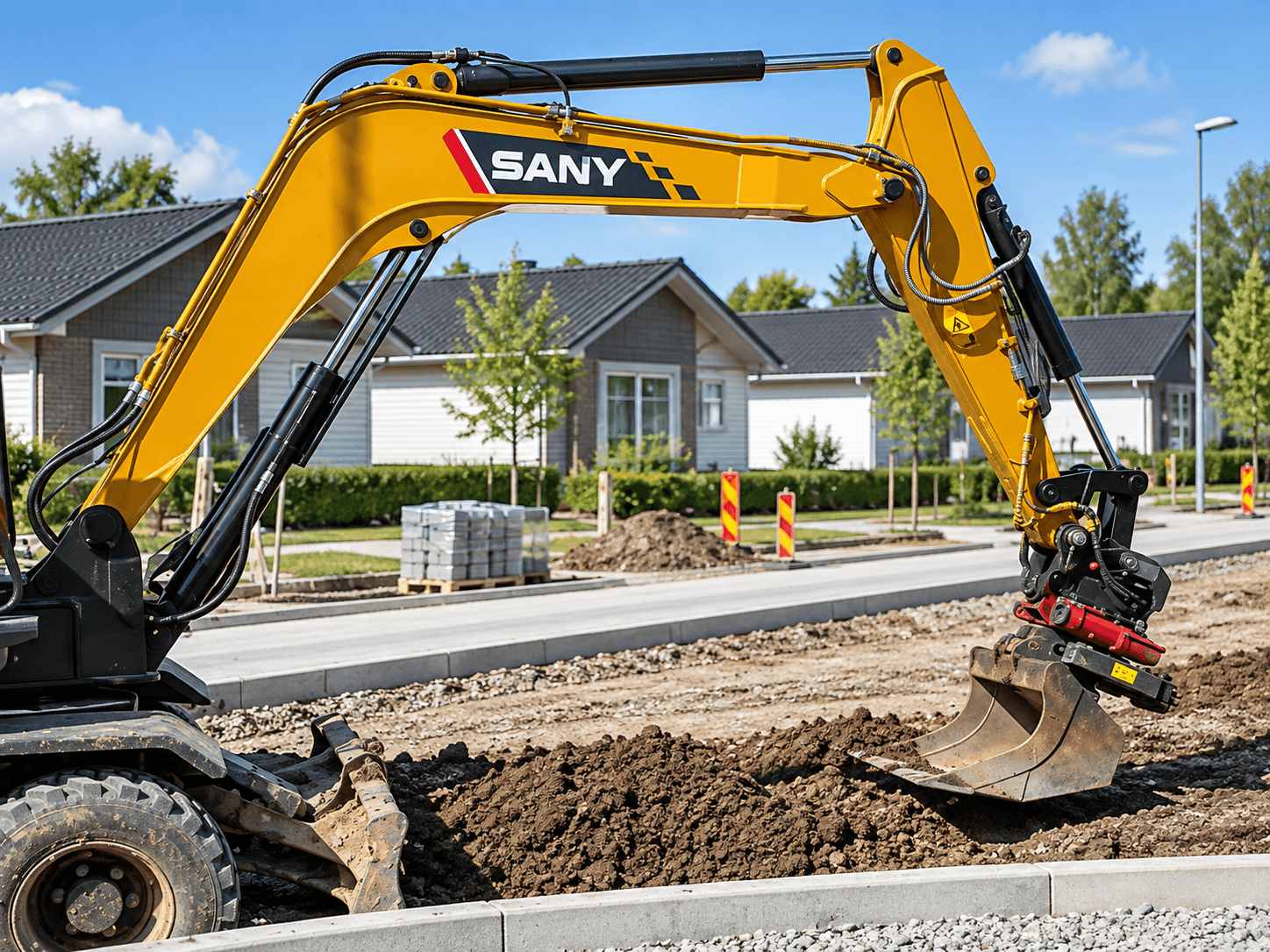
When working along a trench, the excavator may be positioned on uneven ground or within a restricted corridor. Repeatedly tracking the carrier can take time, damage prepared surfaces and increase interaction with other equipment.
A tiltrotator allows the operator to direct the bucket towards different parts of the trench while keeping the excavator in a suitable position.
The rotation function can change the direction of the cutting edge. The tilt function can then match the side slope or drainage profile.
This capability can support:
- Cleaning trench bottoms and edges
- Shaping drainage channels
- Working around pipes and cables
- Forming slopes from one machine position
- Placing and spreading backfill
- Finishing around inspection chambers
- Working beside roads, walls and foundations
The resulting efficiency comes from reducing unnecessary carrier movements and giving the operator more control over the attachment’s working angle.
Keeping Movement Available Across Work Tools
A dedicated tilting ditching bucket can be effective when most of the excavator’s work consists of drainage and grading. A tiltrotator offers broader flexibility when the machine regularly changes attachments.
Because the movement is located above the lower coupler, compatible digging buckets, grading buckets and other work tools can use the same rotation and tilt functions.
This makes the complete system different from a single swivel bucket. The operator can change the work tool without losing the positioning capability provided by the tiltrotator.
Automatic quick-coupler functions can also support efficient attachment changes when the complete machine and attachment system have been correctly configured.
Control Is as Important as Movement
Trench work often takes place close to underground services. Greater movement must therefore be combined with predictable control.
CATSU proportional operation allows the operator to regulate the speed of tilt and rotation. Small joystick inputs can produce controlled changes in attachment position, helping the operator work near pipes, cables, kerbs or completed surfaces.
The tiltrotator does not replace correct excavation procedures, utility location, stability assessment or operator training. It gives the operator additional control after the machine has been positioned appropriately.
Selecting the Correct System
Before selecting a swivel attachment for excavator work, buyers should confirm exactly which movements are required.
Important questions include:
- Is lateral tilt sufficient?
- Is continuous rotation required?
- Will more than one attachment need the movement?
- What coupler standard is installed?
- What hydraulic pressure and oil flow are available?
- Does the excavator support proportional control?
- What work tools will be connected below the system?
CATSU supplies tiltrotators for excavators from 1 to 26 tonnes. Correct selection is based on the excavator model, mounting dimensions, hydraulic configuration, coupler interface and intended application.
Greater Efficiency Through Better Positioning
A tilting ditching bucket adds useful movement to a specific bucket. A complete tiltrotator makes tilt and rotation available to multiple compatible attachments.
For contractors comparing a swivel bucket with a complete tiltrotator, the main consideration is how many tasks and work tools require additional positioning.
When properly matched and operated, the system can help the excavator complete trench shaping, drainage work and backfilling with fewer machine movements and more controlled attachment positioning.
Contact CATSU with your excavator specifications, hydraulic information and attachment list to discuss the correct configuration.
360 Rotating Excavator Bucket vs. Mini Excavator Tilting Bucket: Which System Improves Efficiency?
Mini Excavator Tilt Grading Bucket: How Tiltrotator Control Improves Grading Efficiency


